
The 10 best Greenhouse alternatives for small and growing teams
Greenhouse is the structured-hiring standard, with quote-only pricing. Compare 10 Greenhouse alternatives by price, AI screening and fit for smaller teams.
Sayandeep Das12 min read
Fluxberry is our product and is on this list. Check each vendor’s pricing and features before you buy.

Key takeaways
- Greenhouse is the benchmark for structured hiring, with interview kits, scorecards, 400+ integrations and AI Talent Matching on every plan. Its pricing is quote-only and it has no trial.
- The closest like-for-like Greenhouse competitors are Ashby, Lever and Workable; Pinpoint and Teamtailor suit in-house and brand-led teams.
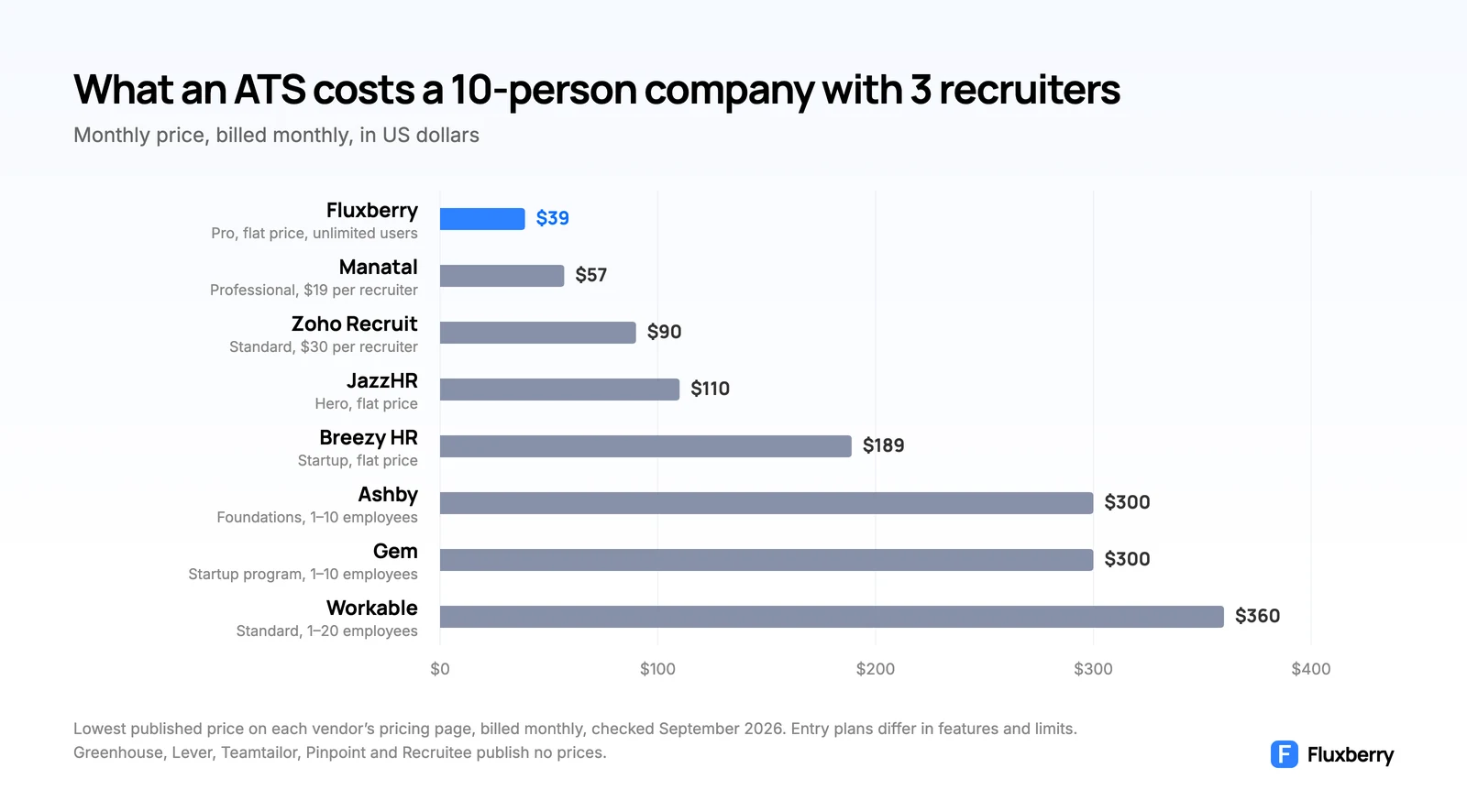
- Breezy HR, JazzHR, Manatal and Fluxberry publish much lower prices, but check which structured-hiring features you would give up.
- Fluxberry fits small teams that want every applicant scored with written reasoning at a flat price. It doesn't have interview kits or scorecards yet, so it isn't a replacement for Greenhouse's structured interviews.
Greenhouse is the applicant tracking system most growing companies measure the others against. It turned structured hiring (the same interview plan, questions and scorecard for every candidate in a role) into software, and more than 7,500 companies use it, according to Greenhouse.
That rigour comes with a sales-led buying process and pricing that isn't published, and for a 20- or 50-person company it can be more system than the team needs. This guide compares ten Greenhouse alternatives on price, AI screening and how much of Greenhouse's structured-hiring toolkit each one covers. We make Fluxberry, which is on this list; every other tool is described from its own website, checked in September 2026.
The 10 best Greenhouse alternatives at a glance
| Tool | Best for | Starting price | Trial |
|---|---|---|---|
| Fluxberry | Small teams that want AI scoring at a flat price | $39/month | No |
| Ashby | Analytics-led scaling companies | $300/month (1–10 employees) | Demo only |
| Lever | ATS and recruiting CRM in one | Quote only | Demo only |
| Workable | Growing companies that want wide job-board reach | $299/month, billed annually | 15 days |
| Teamtailor | Employer-brand-led hiring | Quote only | Demo only |
| Pinpoint | Multi-location in-house teams | Quote only | On request |
| JazzHR | US small businesses on a fixed budget | $1,000/year | No |
| Recruitee | Collaborative hiring in Europe | Quote only | 18 days |
| Breezy HR | Flat pricing with AI scoring | $157/month, billed annually | 14 days |
| Manatal | Low per-user pricing with AI scoring | $15 per user/month, billed annually | 14 days |
What is Greenhouse?
Greenhouse is an applicant tracking system built around structured hiring. It gives every role an interview plan with defined focus areas, question kits and scorecards, then collects each interviewer's feedback before the team compares notes. Around that core sit a sourcing CRM, scheduling, reporting, offers with e-signature, and over 400 pre-built integrations. It is sold in three plans (Core, Plus and Pro), all priced by quote.
Greenhouse has also moved quickly on AI. Real Talent bundles Talent Matching (which prioritises applicants against weighted criteria that recruiters set, and is included on every plan) with spam and fraud detection and CLEAR identity verification on Plus and Pro. In May 2026 Greenhouse bought Ezra AI Labs, which makes a voice AI interviewer.
Why teams look for Greenhouse alternatives
- Pricing you can't see. Core, Plus and Pro are all quote-only, shaped by plan, hiring volume and complexity. You can't compare Greenhouse on price without a sales process.
- No way to try it first. Greenhouse is demo-only, with no trial.
- Useful automation sits on higher plans. Auto-reject and auto-advance, email automation and texting start at Plus; an audit log and a developer sandbox are Pro-only.
- More structure than a small team uses. Greenhouse pays off when many interviewers run many loops. A company making a handful of hires a year often uses a fraction of it.
If your team runs a genuinely structured process at volume, those reasons may not apply, and the section on when to stay is for you.
How we chose these Greenhouse alternatives
Every tool here is an applicant tracking system a small or growing company could realistically move to from Greenhouse. We compared them on structured-hiring features (interview plans, scorecards, approvals, offers), how their AI screening works, published pricing, trial availability and how data gets in and out. Facts come from each vendor's own pricing and product pages, checked in September 2026 and linked in each entry. Several of these tools are demo-only, and we haven't used those ourselves. Confirm anything you depend on with the vendor, since pricing changes often.
The best Greenhouse alternatives
1. Fluxberry
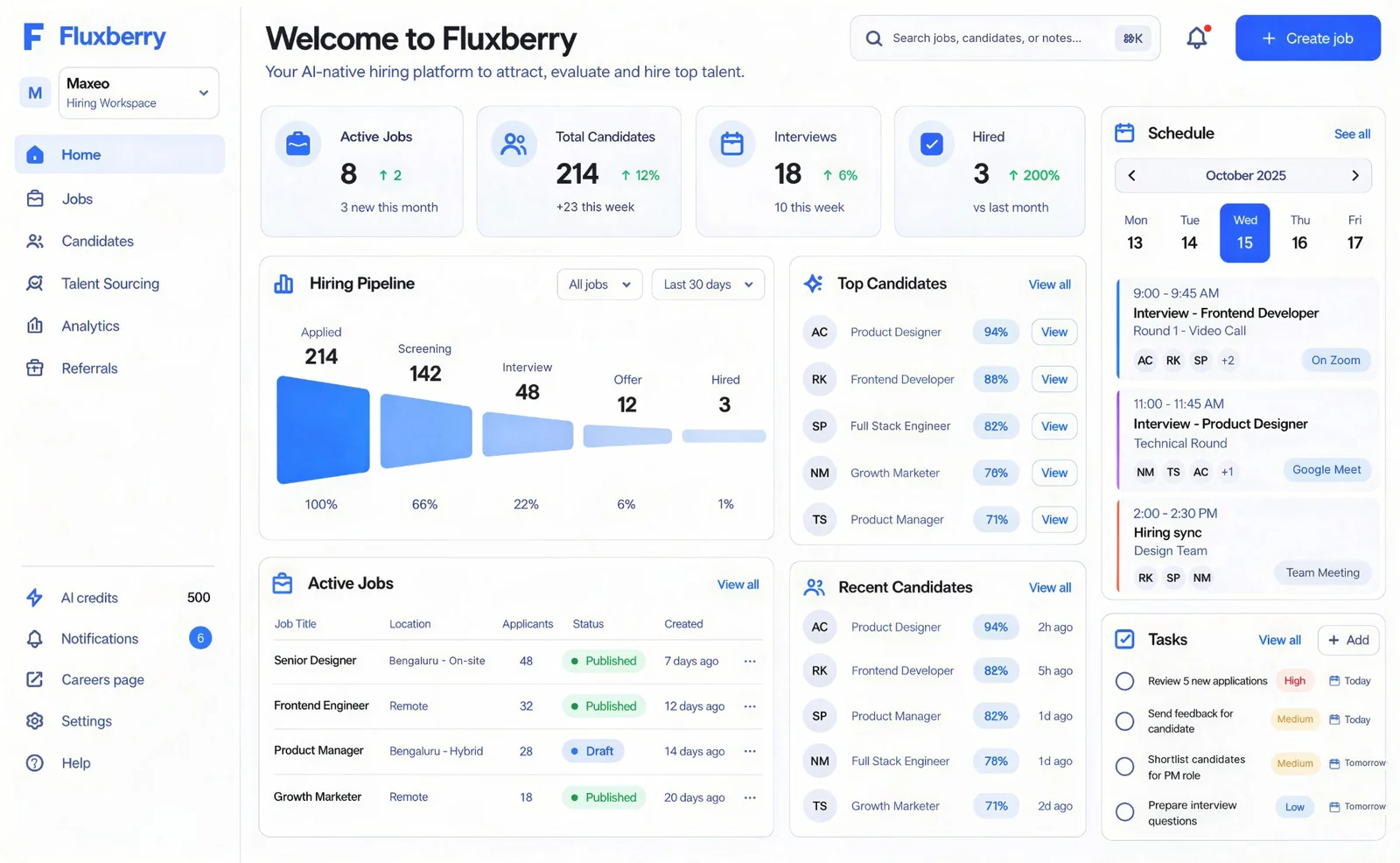
Fluxberry is an AI-native applicant tracking system for small teams. Each applicant is scored against the job the moment they apply, on a 0–10 scale built from fixed weights for skills, experience, relevance, location, compensation and education, with a written summary, strengths and concerns. Jobs, a branded careers page, the pipeline, Google Calendar interviews, offers and analytics all sit in one workspace, with unlimited team members.
Best for: Small teams that want applicants triaged for them and don't need Greenhouse's structured-interview depth.
Compared with Greenhouse, Fluxberry is much lighter: it has no interview kits, scorecards or approval chains yet, and no integration marketplace. What it adds is a scored, explained shortlist for every role at a published, flat price.
Pros:
- Flat price with unlimited jobs, candidates and team members
- Every score comes with its breakdown and written reasoning
- A job can be live on your careers page the same day
Cons:
- No structured interview kits, scorecards or approval workflows yet
- Offers are sent as a link the candidate accepts online, without e-signature
- No native integrations; hires reach other systems through signed webhooks and an automation tool
- No free plan or trial, and no self-serve bulk import
Pricing: Pro is $39/month or $199/year; Max, with talent sourcing and referrals, is $59/month or $299/year.
2. Ashby
Ashby is an all-in-one ATS with a CRM, scheduling and unusually deep analytics built in. Its AI-Assisted Application Review marks each resume as meeting or not meeting criteria you set, without an overall score.
Best for: Scaling companies that want reporting and analytics without a BI tool.
Compared with Greenhouse, Ashby has more analytics and CRM included and publishes prices for companies under 100 employees; Greenhouse has the larger integration ecosystem.
Pros: Published Foundations pricing; structured scorecards and offers with e-signature; 250+ integrations.
Cons: Custom fields, custom reports and approvals need the quote-only Plus plan; demo only; SSO costs extra on Foundations.
Pricing: Foundations runs from $300/month (1–10 employees) to $900/month (76–100), 10% less billed annually. Our Ashby alternatives guide covers its weak spots in more detail.
3. Lever
Lever, owned by Employ, pairs an ATS with a recruiting CRM for nurturing candidates over time. Its AI-powered screening gives applicants a fit score with a written justification, and AI interview transcripts and summaries are part of the core platform.
Best for: Teams that hire from a long-running talent pipeline.
Compared with Greenhouse, Lever is stronger on candidate relationships and puts AI scoring and interview summaries in its core platform. Greenhouse is stronger on structured interviewing and integrations.
Pros: ATS and CRM in one; AI fit scores with explanations; 300+ integrations.
Cons: Pricing on request; no trial; onboarding and some AI screening options are quoted add-ons.
Pricing: Quote only.
4. Workable
Workable is an all-round ATS with posting to 200+ job boards, a careers page builder, interview kits and scorecards, and offers with e-signatures. The Workable Agent scores candidates on up to 14 criteria and returns a ranked shortlist with reasoning.
Best for: Growing companies that want broad job-board reach and the option to add HR tools later.
Compared with Greenhouse, Workable is quicker to set up and you can try it first; Greenhouse goes further on structured-hiring configuration.
Pros: 15-day trial without a card; unlimited active jobs; 270+ integrations.
Cons: Priced by company size, so small teams still pay $299/month or more; texting, video and assessments are add-ons on Standard; AI agent work is billed in credits.
Pricing: Standard is $299/month billed annually ($360 monthly) for 1–20 employees.
5. Teamtailor
Teamtailor puts the career site first: a builder in 50+ languages, employer-brand content, a talent CRM, interview kits and e-signed offers. Its AI features, including the Co-pilot add-on, summarise resumes and flag promising applicants.
Best for: Companies that compete for candidates on employer brand.
Compared with Greenhouse, Teamtailor is more candidate-facing and less configurable for complex interview loops.
Pros: Unlimited users and job postings on every plan; 450+ integrations.
Cons: Quote-only pricing; no advertised trial; Co-pilot is a separately activated add-on.
Pricing: Quote only.
6. Pinpoint
Pinpoint is built for in-house talent teams hiring across locations, brands and role types. Its AI Match Score gives each applicant a 1–10 score with strengths, concerns and interview focus areas, and it includes scorecards, offers with e-sign and onboarding.
Best for: In-house teams of one to five recruiters at companies with 50 to 5,000 employees.
Compared with Greenhouse, Pinpoint is aimed at a similar buyer, with explained AI scores and pricing based on company size rather than seats.
Pros: Hiring managers at no extra cost; managed switching from other ATSs.
Cons: No public pricing; four to six weeks to implement; managed migration costs extra.
Pricing: Quote only.
7. JazzHR
JazzHR, another Employ product, is an easy-to-run ATS for small businesses with flat annual plans. Its Talent Fit feature ranks candidates against the job and explains each match on the Plus plan and above.
Best for: US small businesses that want predictable pricing.
Compared with Greenhouse, JazzHR is far simpler and publishes its prices; it has much less structured-hiring depth.
Pros: Published flat pricing; structured interviews and assessments on Plus; offers with e-signatures on Pro.
Cons: No trial; Hero limits job postings; standard pricing excludes companies over 250 employees and staffing agencies.
Pricing: Hero is $1,000/year ($110 monthly), Plus $3,480/year ($350 monthly) and Pro $5,508/year ($549 monthly).
8. Recruitee
Recruitee, now part of Tellent, is a collaborative ATS popular with European companies, with GDPR automation built in. Its Screening Assistant checks applications against up to six criteria and shows how many are met; by design it doesn't give rankings or suitability scores.
Best for: European teams that want collaborative, GDPR-ready hiring.
Compared with Greenhouse, Recruitee is simpler and you can try it before you buy; its AI deliberately stops short of ranking people.
Pros: An 18-day trial; 200+ integrations; WhatsApp hiring and agency tools as add-ons.
Cons: No public pricing; the Start plan is capped at five job posts; full AI screening is on the top plan only.
Pricing: Quote only, across Start, Advance and Optimize.
9. Breezy HR
Breezy HR offers flat monthly plans, one-click posting to 50+ job boards and a visual pipeline. Applicant Insights gives each candidate a 0–10 score against the job with a written explanation, paid for with credits.
Best for: Budget-conscious teams that want flat pricing and AI scoring.
Compared with Greenhouse, Breezy is simpler and much cheaper, with scorecards and interview guides from the Growth plan and offer approvals on Business.
Pros: Flat pricing, not per user; a 14-day trial; a free plan for one active job.
Cons: Scorecards need Growth ($273/month); API and bulk export/import are on Custom Pro.
Pricing: Startup is $157/month billed annually ($189 monthly).
10. Manatal
Manatal is an AI-first ATS and recruitment CRM used by in-house teams and agencies, with posting to 2,500+ job boards. It scores and recommends candidates automatically, with weighting you can adjust, on every plan.
Best for: Small teams and agencies that want AI scoring at a low per-user price.
Compared with Greenhouse, Manatal is dramatically cheaper for one or two recruiters, with much lighter structured-hiring tools.
Pros: Unlimited hiring managers; a 14-day trial; AI scoring on all plans.
Cons: Priced per user; Professional is capped at 15 jobs; API and SSO need Enterprise Plus.
Pricing: Professional is $15 per user/month billed annually ($19 monthly); Enterprise $35.
Greenhouse features to match before you switch
Greenhouse users tend to rely on a specific set of features. Here is where each one lives among the alternatives, based on their own feature pages:
| Greenhouse feature | Alternatives that offer it | Not in |
|---|---|---|
| Interview kits and scorecards | Ashby, Workable, Teamtailor, Pinpoint, JazzHR (Plus), Breezy HR (Growth) | Fluxberry |
| AI applicant scoring or matching | Fluxberry, Lever, Workable, Pinpoint, Breezy HR, Manatal, JazzHR (Plus) | Ashby and Recruitee check criteria without an overall score |
| Offers with e-signature | Ashby, Workable, Teamtailor, Pinpoint, JazzHR (Pro) | Fluxberry (online acceptance only) |
| Approval workflows | Ashby (Plus), Breezy HR (Business) | Fluxberry |
| 250+ integrations | Teamtailor, Lever, Workable, Ashby | Fluxberry |
| Fraud and fake-resume detection | Ashby, Lever, Breezy HR | Fluxberry |
If interview kits, scorecards and approvals are the reason you bought Greenhouse, shortlist from the first column and test those features in a trial or demo before anything else.
How to switch from Greenhouse
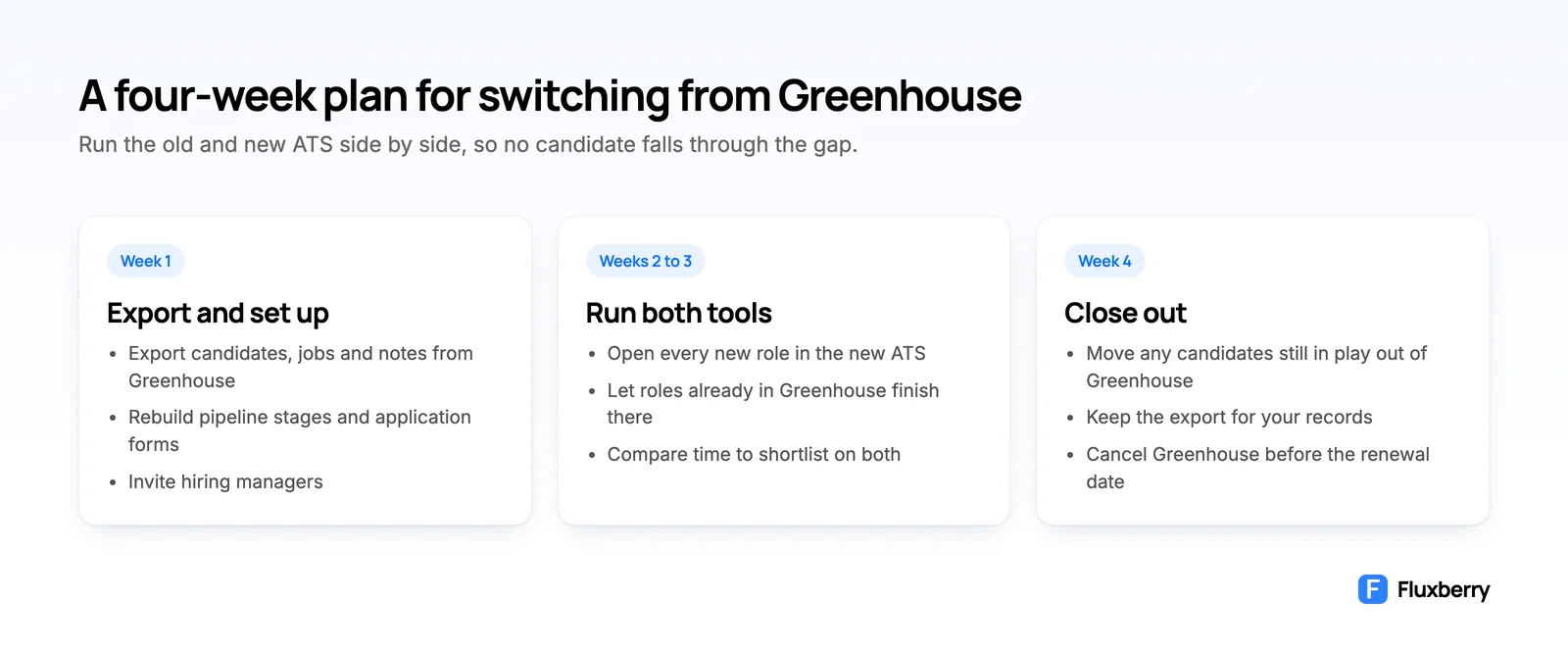
- Get your data out. Greenhouse's essential candidate report exports to a spreadsheet, up to 1,000 applications per report, and its Harvest API exists for full exports. If you use Harvest, note that its v1 and v2 versions were retired on 31 August 2026 in favour of v3.
- Write down your interview plans. Copy each role's stages, focus areas and scorecard questions before you lose access; they are the most valuable part of a Greenhouse setup.
- Run both for two to three weeks. Open new roles in the new ATS and let roles already in Greenhouse finish there.
- Close out before renewal. Move anyone still active, archive the export, and give notice in line with your contract.
With Fluxberry there is no self-serve import yet, so start new roles in Fluxberry and let Greenhouse finish the rest.
When Greenhouse is still the right choice
Stay on Greenhouse if many interviewers run structured loops every week, if hiring managers depend on its scorecards and approval chains, or if it sits at the centre of a large integration stack. In those cases the alternatives above save money by removing the things that make your process work. For extending Greenhouse instead, see the tools that integrate with Greenhouse.
Try Fluxberry if Greenhouse is more than you need
If you are a small team whose real bottleneck is reading applications rather than running interview loops, Fluxberry scores every applicant with the reasoning written out, for a flat price. Create your Fluxberry workspace and run it on your next role. For a wider comparison, see our guide to the best applicant tracking systems for small businesses or the full map of recruiting software by type.
Frequently asked questions
What is the best Greenhouse alternative?
For structured hiring at a similar depth, Ashby, Workable and Pinpoint are the closest; for a CRM-led process, Lever. For small teams on a budget, Breezy HR, JazzHR and Manatal publish much lower prices, and Fluxberry scores every applicant with written reasoning from $39/month.
How much does Greenhouse cost?
Greenhouse doesn't publish prices. All three plans, Core, Plus and Pro, are quoted based on your plan, hiring volume and complexity, and you need a demo to get a number.
Is Greenhouse good for small businesses?
It can be, if a small business runs a structured interview process and hires regularly. Very small teams that make a few hires a year often pay for features they don't use, and a lighter ATS with published pricing is usually a better fit.
Does Greenhouse have AI screening?
Yes. Talent Matching, part of Greenhouse Real Talent, prioritises applicants against weighted criteria that recruiters define and is included on every plan. Greenhouse says it never advances or rejects candidates on its own.
What is cheaper than Greenhouse?
Tools with published prices include Fluxberry (from $39/month flat), Manatal (from $15 per user/month billed annually), JazzHR (from $1,000/year), Breezy HR (from $157/month billed annually) and Workable (from $299/month billed annually).
How do I migrate from Greenhouse?
Export candidates with the essential candidate report or the Harvest API, record your interview plans and scorecards, then run the old and new systems side by side for a few weeks so that no candidate is dropped mid-process.
Founder of Fluxberry
Sayandeep builds Fluxberry, an AI native hiring platform for small teams, and writes about applicant tracking systems, recruiting software and running a faster hiring process.