
The 9 best Ashby alternatives for startups and small teams
Ashby is powerful but priced and built for scaling teams. Compare 9 Ashby alternatives, including Fluxberry, Greenhouse, Lever and Workable, by price and fit.
Sayandeep Das14 min read
Fluxberry is our product and is on this list. Check each vendor’s pricing and features before you buy.

Key takeaways
- Ashby is one of the strongest all-in-one ATS platforms, with its CRM, scheduling and analytics built in. Most teams that leave it do so over price, admin depth or AI that doesn't score applicants.
- Ashby's Foundations plan costs $300 to $900 a month depending on headcount (up to 100 employees), and custom fields, custom reports and approvals need the Plus plan.
- Greenhouse and Lever are the closest like-for-like alternatives; Workable, Breezy HR and Zoho Recruit publish lower prices; Gem is strongest for sourcing.
- Fluxberry suits small teams that want every applicant scored with written reasoning, at a flat price with unlimited team members. It has no native integrations or interview recording yet.
Ashby is one of the strongest applicant tracking systems a scaling company can buy. It puts the ATS, a recruiting CRM, scheduling and unusually deep analytics in one product, and growth has followed: Ashby reported more than 2,700 customers when it raised a $50M Series D in July 2025.
But depth has a price, in money and in setup time, and not every team needs it. If you are a startup or small team weighing Ashby alternatives, this guide compares nine of them on what they cost, what their AI actually does, and who each one suits. We make Fluxberry, which is on this list; every other tool is described from its own pricing and product pages, checked in September 2026.
The 9 best Ashby alternatives at a glance
| Tool | Best for | Starting price | Pricing basis |
|---|---|---|---|
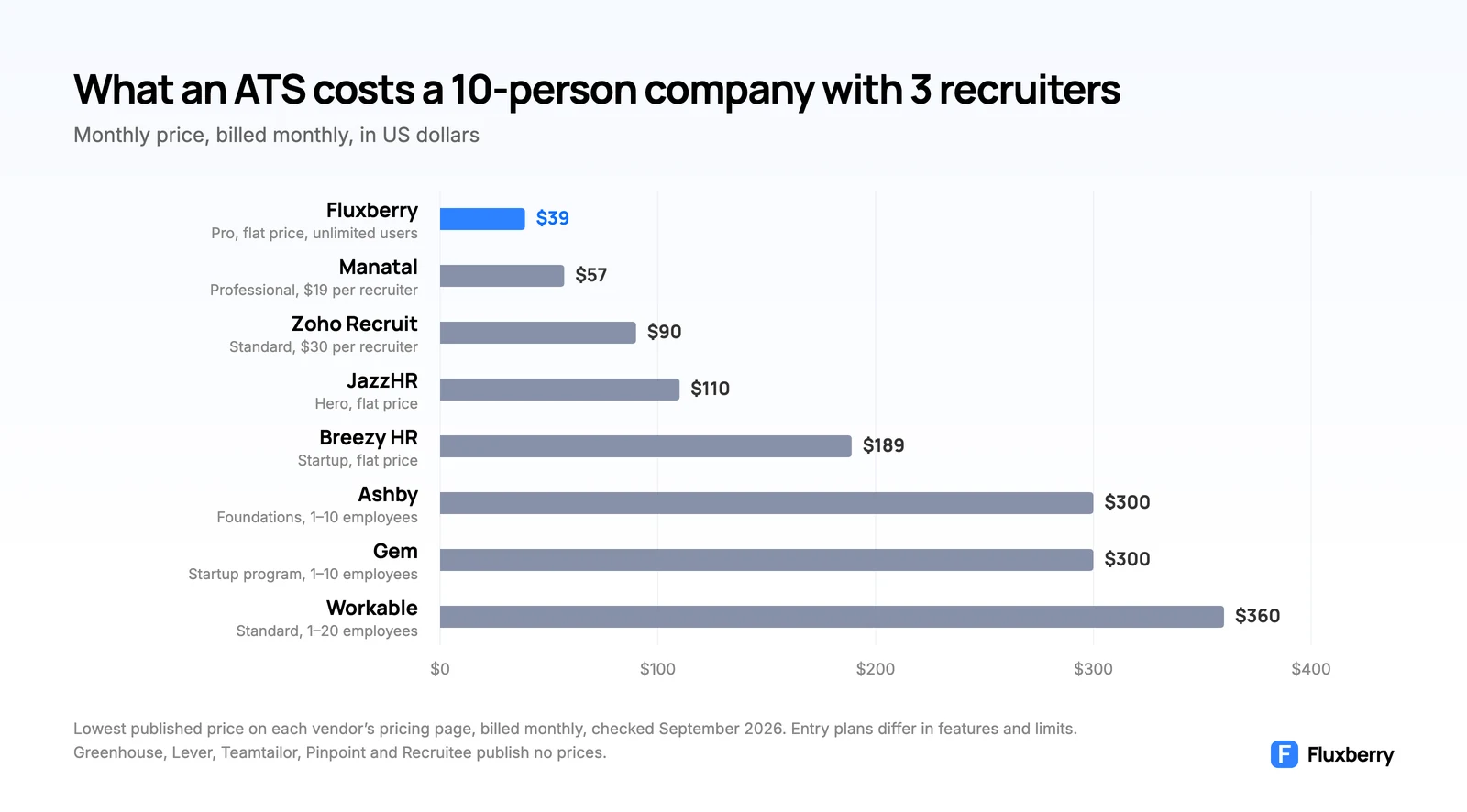
| Fluxberry | Small teams that want AI scoring at a flat price | $39/month | Flat, unlimited team members |
| Greenhouse | Structured hiring at mid-size companies | Quote only | Plan and hiring volume |
| Lever | ATS and recruiting CRM in one | Quote only | Team size and needs |
| Gem | Sourcing-heavy teams | $300/month (1–10 employees) | Company headcount |
| Workable | Growing teams that want AI sourcing | $299/month, billed annually | Company headcount |
| Teamtailor | Employer-brand-led hiring | Quote only | Not published |
| Pinpoint | In-house teams at 50+ employee companies | Quote only | Company size, not seats |
| Breezy HR | Budget teams that want flat pricing | $157/month, billed annually | Flat per plan |
| Zoho Recruit | Teams already on Zoho | $25 per recruiter/month, billed annually | Per recruiter |
Why teams look for Ashby alternatives
Ashby's strengths are real, so it is worth being precise about why teams still look elsewhere. Four reasons come up most:
- Price for a small team. Ashby's Foundations plan is priced by company headcount rather than seats: $300 a month for 1–10 employees, rising to $900 a month at 76–100 employees, with 10% off for paying annually. SSO is $100 a month on Foundations, and the AI Notetaker is an add-on on every plan. For a ten-person startup hiring two people a year, that is a lot of software.
- Features you have to grow into. Custom fields, custom saved reports and dashboards, approval workflows and a sandbox are not on Foundations; they start at Plus, which is quote-only and seat-based. On seat-based plans, hiring managers with open roles need paid seats; interviewers who only leave feedback do not.
- AI that checks criteria rather than scoring people. Ashby's AI-Assisted Application Review marks each resume as meeting or not meeting criteria you write, with citations. Ashby says it never gives applicants a numerical rating; you can sort by the share of criteria met. That is a defensible design choice, but some teams want an overall score and a written summary for every applicant.
- A demo before anything else. There is no free trial of the ATS, so you can't try it on a live role before talking to sales.
None of these make Ashby a bad choice. They make it a choice for a particular kind of team, which is why the alternatives below are sorted by who they suit.
How we chose these Ashby alternatives
We looked for applicant tracking systems that a startup or small team could realistically move to from Ashby, and scored them on five things: core ATS depth, how AI screening works, price at 10 and 50 employees, how quickly you can get started, and how easily your data comes with you. Prices, trials and AI features come from each vendor's own website, checked in September 2026, and are linked in each entry. We have not used the demo-only products ourselves, and we say so where it matters. Check anything you rely on with the vendor before you buy, because pricing in this category changes often.
The best Ashby alternatives
1. Fluxberry
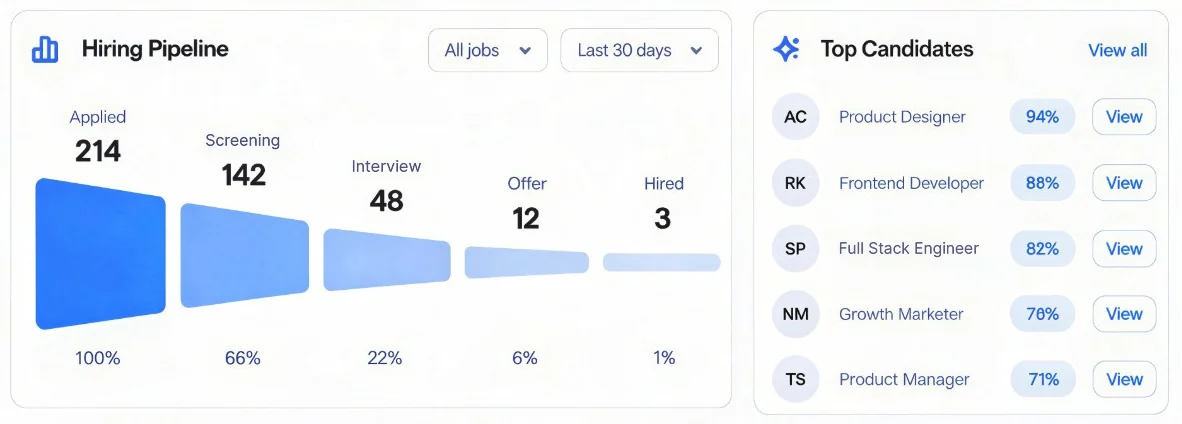
Fluxberry is an AI-native applicant tracking system for small teams. Every applicant is parsed and scored against your job the moment they apply, with a 0–10 score built from fixed weights (skills, experience, relevance, location, compensation and education), a written summary, strengths and concerns. You open a ranked shortlist instead of a pile.
Best for: Startups and small teams that want applicants scored, with the reasoning written out, at a flat monthly price.
Compared with Ashby, Fluxberry is far narrower: there is no recruiting CRM with multi-step sequences, no interview scorecards, no advanced scheduling and much lighter analytics. What it does differently is score every applicant with a visible breakdown, and charge one flat price however many people join the hiring team.
Key features:
- AI scoring with a weighted breakdown, summary, strengths and concerns for every applicant
- Custom pipeline stages, application forms and a branded careers page
- Interviews booked on Google Calendar, offers and candidate email in one place
- Analytics on sources, time in stage and funnel drop-off
- Talent sourcing and referrals on the Max plan
Pros:
- Flat price with unlimited jobs, candidates and team members
- Scores are explained, not just ranked
- You can publish a job and collect applications the same day
Cons:
- No native integrations with other ATSs or HR systems yet; hires reach them through signed webhooks and an automation tool such as Zapier
- No structured interview kits, scorecards or approval workflows yet
- No interview recording or note-taking
- No free plan or trial, and no self-serve bulk import yet
- A young product, without the depth of reporting Ashby has
Pricing: Pro is $39/month or $199/year. Max, which adds talent sourcing and referrals, is $59/month or $299/year.
Switching from Ashby: Run new roles in Fluxberry while existing ones finish in Ashby (see the plan below).
2. Greenhouse
Greenhouse is the standard for structured hiring: interview kits, scorecards, approvals and a marketplace of over 400 pre-built integrations. Its Talent Matching, part of Real Talent, prioritises applicants against weighted criteria that recruiters set, and it is included on all three plans.
Best for: Mid-size companies that want a rigorous, repeatable interview process and a large integration ecosystem.
Compared with Ashby, Greenhouse has the bigger marketplace and a longer track record with structured interviewing; Ashby has more analytics and CRM built in without add-ons.
Pros: Mature structured-hiring tools; Talent Matching included on every plan; fraud detection and ID verification on Plus and Pro.
Cons: Quote-only pricing across Core, Plus and Pro; demo only, no trial; auto-reject, email automation and texting start at Plus.
Pricing: Quote only.
Switching from Ashby: Plan for a longer implementation; Greenhouse's value comes from configuring interview plans properly. Our guide to Greenhouse integrations covers the tools teams connect to it.
3. Lever
Lever combines an ATS with a recruiting CRM, so passive candidates and past applicants can be nurtured over months. Its core platform includes AI-powered screening that gives applicants a fit score with a written justification, plus AI interview transcripts and summaries. Lever is owned by Employ, which also owns JazzHR and Jobvite.
Best for: Teams that recruit from a long-term talent pipeline as much as from inbound applications.
Compared with Ashby, Lever's CRM is the centre of the product rather than one module; Ashby's analytics are deeper out of the box.
Pros: Strong candidate relationship tools; AI fit scores and interview summaries in the core platform; 300+ integrations in its marketplace.
Cons: Pricing on request and no trial; several add-ons, including onboarding, are quoted separately.
Pricing: Quote only.
Switching from Ashby: Lever and Ashby cover similar ground, so most stages and scorecards map across. See our Lever integrations guide for the tools around it.
4. Gem
Gem started as a sourcing and CRM layer and now sells an all-in-one platform with its own ATS. Its AI Application Review Agent scores and ranks every inbound application with an explanation, and its sourcing agent searches 800M+ profiles.
Best for: Teams whose hiring depends on outbound sourcing as much as inbound applications.
Compared with Ashby, Gem is stronger on sourcing and outreach; Ashby is the more established ATS.
Pros: Sourcing, CRM and ATS in one; hiring managers get access without using a licence; a startup program for companies under 30 employees (six months free, then 50% off the first paid year).
Cons: Custom pricing above the startup bands; AI agents need the pricier AI-powered seat.
Pricing: Its startup calculator shows $300/month for 1–10 employees billed monthly, and less on annual terms; larger companies get a quote.
Switching from Ashby: Gem offers migration help for teams moving from Greenhouse or Lever; ask about Ashby specifically.
5. Workable
Workable is an all-round ATS for growing companies, with posting to 200+ job boards, a careers page builder and an HR suite you can bundle in. Its Workable Agent, generally available since September 2026, scores candidates on up to 14 criteria and produces a ranked shortlist with reasoning.
Best for: Growing companies that want broad job-board reach and AI sourcing and screening in one tool.
Compared with Ashby, Workable is simpler to run and has a real trial; Ashby is deeper on analytics and CRM.
Pros: 15-day trial without a card; unlimited active jobs; 270+ integrations.
Cons: Priced by company size, so even a small team pays at least $299 a month; texting, video interviews and assessments are add-ons on Standard; the AI agent is billed in credits.
Pricing: Standard is $299/month billed annually ($360 monthly) for 1–20 employees, and $419/month billed annually for 21–50.
Switching from Ashby: Use the trial to rebuild one live role before you commit.
6. Teamtailor
Teamtailor is built around employer branding: a career site builder in 50+ languages, content that shows off your team, and a talent CRM for people who aren't ready to apply. Its AI features, including the Co-pilot add-on, summarise resumes and flag promising applicants as they arrive.
Best for: Companies whose hiring depends on standing out to candidates, especially in Europe.
Compared with Ashby, Teamtailor is weaker on analytics and stronger on the candidate-facing side.
Pros: Unlimited users and job postings on every plan; 450+ integrations; a strong career site out of the box.
Cons: Quote-only pricing and no advertised trial; Co-pilot is a separately activated add-on.
Pricing: Quote only.
7. Pinpoint
Pinpoint is an ATS for in-house talent teams hiring across several locations, brands or role types. Its AI Match Score gives each applicant a 1–10 score with strengths, concerns and areas to probe in interview.
Best for: In-house teams of one to five recruiters at companies with 50 to 5,000 employees, by Pinpoint's own description.
Compared with Ashby, Pinpoint covers similar ground for a similar buyer, with pricing that isn't tied to seats.
Pros: Scored, explained AI matching; hiring managers at no extra cost; managed switching from other ATSs.
Cons: No public pricing; implementation typically takes four to six weeks; managed migration is priced separately.
Pricing: Quote only, based on company size rather than seats.
8. Breezy HR
Breezy HR is a straightforward ATS with flat monthly plans, posting to 50+ job boards and a drag-and-drop pipeline. Its Applicant Insights feature gives each candidate a 0–10 score against the job, with a written explanation.
Best for: Budget-conscious small teams that want flat pricing and AI scoring.
Compared with Ashby, Breezy is much simpler and much cheaper, with far less in the way of analytics and CRM.
Pros: Flat pricing, not per user; a 14-day trial with AI credits; a free plan for a single active job.
Cons: Scorecards and interview guides need the Growth plan; API access and bulk data export/import sit on Custom Pro; AI runs on credits.
Pricing: Startup is $157/month billed annually ($189 monthly); Growth $273; Business $439.
9. Zoho Recruit
Zoho Recruit is a configurable ATS and recruitment CRM that fits naturally into the wider Zoho suite. Its Zia AI matches candidates to jobs; candidate ranking is still listed as coming soon on its AI roadmap.
Best for: Companies already using Zoho, and teams that want deep customisation at a low price.
Compared with Ashby, Zoho Recruit is cheaper and more configurable, but less polished and less focused on startups.
Pros: Low per-recruiter pricing; a 15-day trial; a free plan with one active job.
Cons: Priced per recruiter with active-job caps per licence; many features, including custom reports and webhooks, are Enterprise-only.
Pricing: Standard is $25 per recruiter per month billed annually ($30 monthly), with 10 active jobs per licence; Enterprise is $50.
Ashby alternatives by use case
| If you want… | Consider | Why |
|---|---|---|
| Every applicant scored, at a flat price | Fluxberry | 0–10 scores with written reasoning, unlimited team members |
| The most rigorous structured interviews | Greenhouse | Interview kits, scorecards and 400+ integrations |
| A talent pipeline you nurture for months | Lever | ATS and CRM in one product |
| Outbound sourcing at the core | Gem | Sourcing, CRM and ATS together |
| Wide job-board reach with a trial | Workable | 200+ boards and a 15-day trial |
| A standout career site | Teamtailor | Employer branding is the product's centre |
| The lowest published flat price after Fluxberry | Breezy HR | Flat plans from $157/month billed annually |
| A tool that fits your Zoho stack | Zoho Recruit | Per-recruiter pricing inside Zoho |
What to match before you leave Ashby
Before you switch, list which of these your team actually uses, and check each shortlisted tool against them:
- Analytics: which reports and dashboards do people open every week?
- Scheduling: do you rely on self-booking, availability links or panel scheduling?
- Structured interviews: interview plans and scorecards per role.
- AI review: the criteria you've written for AI-Assisted Application Review, which you can reuse as screening criteria elsewhere.
- CRM and sequences: any nurture campaigns that are still running.
- Integrations: your HRIS, background checks, assessments and calendar.
If the honest answer is "all of them", Ashby may still be the right tool, and the real question is whether Plus is worth it.
How to switch from Ashby
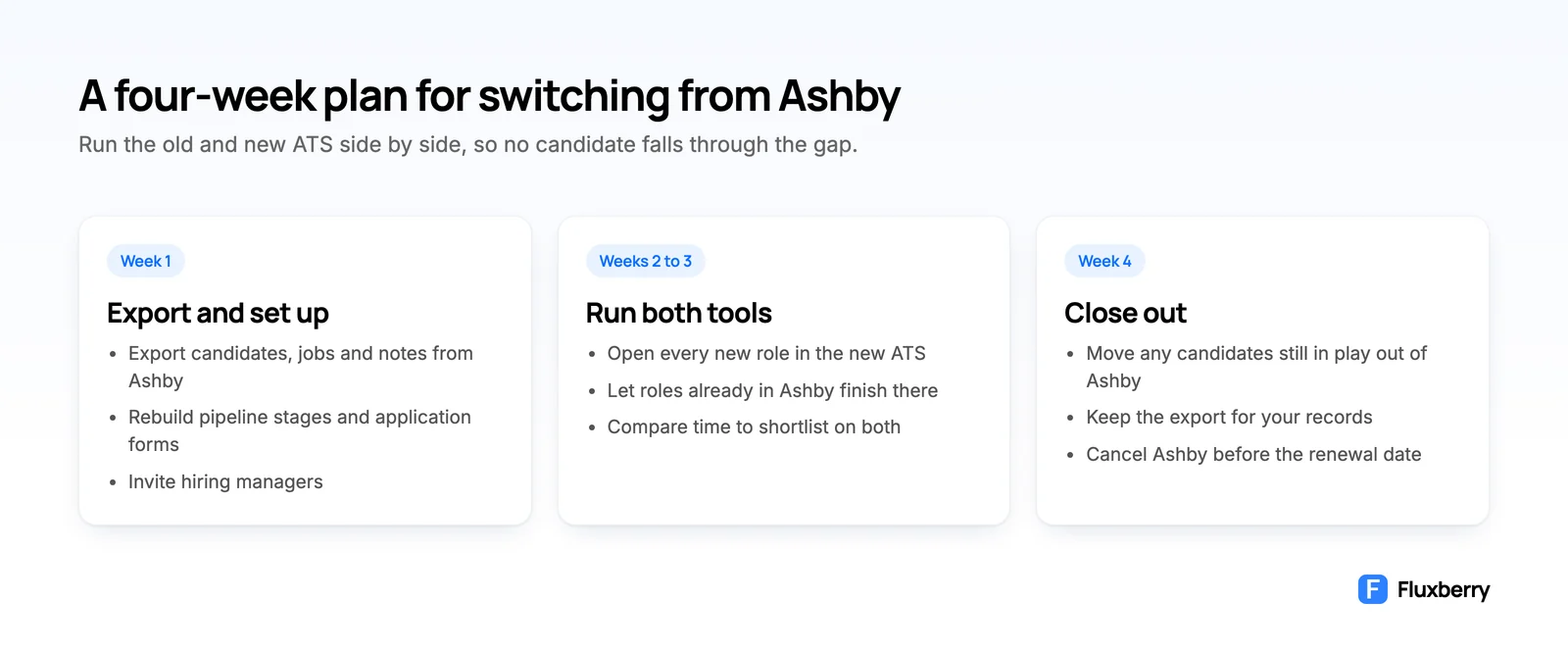
- Export first. Ashby exports candidate lists to CSV through Custom List reports, which aren't available on Foundations; per-candidate exports come as PDFs, and a bulk resume export goes through Ashby's support team. Ask for it early.
- Rebuild, don't copy. Recreate your pipeline stages, application forms and scorecards in the new tool. It is a good moment to cut stages nobody uses.
- Run both for two to three weeks. Open every new role in the new ATS and let roles already in Ashby finish there. That way no candidate is left mid-process.
- Close out before renewal. Move anyone still in play, keep the export for your records, and cancel before the renewal date.
With Fluxberry specifically, there is no self-serve import screen yet, so the side-by-side run above is the simplest path: new roles start in Fluxberry the day you sign up.
When to stay on Ashby
Stay if your company is past 100 people with a recruiting team that lives in Ashby's analytics, if you run CRM sequences at volume, or if you have built custom reports and approval workflows on Plus. Moving would cost more than it saves. The alternatives above make the most sense for smaller teams that are paying for depth they don't use.
Try Fluxberry as your Ashby alternative
If your team is small and your real problem is reading every application, Fluxberry scores each one with the reasoning written out, for one flat price. Create your Fluxberry workspace and run it on your next role. For more options beyond Ashby's direct rivals, see our guide to the best applicant tracking systems for small businesses, and if you are also weighing Greenhouse, our Greenhouse alternatives guide covers that side.
Frequently asked questions
What is the best alternative to Ashby?
It depends on why you are leaving. For rigorous structured hiring, Greenhouse is the closest match; for a CRM-led process, Lever; for sourcing, Gem. For a small team that wants every applicant scored at a flat price, Fluxberry is built for exactly that, from $39/month.
Is Ashby an ATS?
Yes. Ashby is an all-in-one applicant tracking system that also includes a recruiting CRM, sourcing, interview scheduling and analytics. It can also be bought as an analytics layer on top of another ATS for companies with more than 100 employees.
How much does Ashby cost?
Ashby's Foundations plan, for companies with up to 100 employees, costs $300 to $900 a month depending on headcount, with 10% off for annual payment (as of September 2026). The Plus and Enterprise plans are quote-only and priced per seat. SSO and the AI Notetaker cost extra on Foundations.
Is Ashby good for small startups?
Ashby is designed to scale from startups to enterprises, and its Foundations plan is aimed at companies under 100 people. Very small teams often find that $300 a month or more, plus features locked to Plus, is more than they need, which is when a lighter ATS makes sense.
Does Ashby have AI screening?
Yes. AI-Assisted Application Review checks each resume against criteria you define and marks each one as met or not met, with citations. Ashby says it never gives applicants a numerical rating, though you can sort applicants by the percentage of criteria they meet. Credits are included on every plan.
Can I move my candidates from Ashby to another ATS?
Yes, but plan it. Candidate CSV exports come from Custom List reports, which aren't on the Foundations plan, and bulk resume exports go through Ashby's support. Many teams run both systems side by side for a few weeks rather than migrating every past candidate.
Founder of Fluxberry
Sayandeep builds Fluxberry, an AI native hiring platform for small teams, and writes about applicant tracking systems, recruiting software and running a faster hiring process.