
The 10 best applicant tracking systems for small businesses and startups
The 10 best applicant tracking systems for small teams in 2026, compared on price, AI screening and setup, with a buyer’s guide to choosing the right one.
Sayandeep Das14 min read
Fluxberry is our product and is on this list. Check each vendor’s pricing and features before you buy.

Key takeaways
- An applicant tracking system (ATS) collects every application in one place, moves candidates through your stages and keeps the team’s feedback and decisions together.
- For small businesses, price model matters as much as price: flat plans, company-size bands, per-recruiter and per-employee pricing all scale differently.
- Most ATSs now use AI on applications, but differently: some score and rank, some check criteria without scoring, and some only match. Ask to see the reasoning.
- Our picks: Fluxberry for explained AI scoring at a flat price, Greenhouse for structured hiring, Ashby for analytics, Lever for CRM, Workable for job-board reach and Breezy HR on a budget.
Most small businesses start hiring in an inbox and a spreadsheet, and it works until the second or third open role. Then applications go unread, candidates wait a week for a reply, and nobody can say where anyone stands. That is the point where an applicant tracking system pays for itself.
This guide covers the ten best applicant tracking systems for small businesses and startups in 2026, what each costs, how their AI actually works, and how to choose. We make Fluxberry, which is one of the ten; everything about the others comes from their own websites, checked in September 2026, and is linked so you can verify it.
Quick picks:
- Fluxberry for explained AI screening at a flat price
- Greenhouse for structured hiring
- Ashby for analytics-led startups
- Lever for an ATS with a built-in CRM
- Workable for wide job-board reach
- Teamtailor for employer branding
- BambooHR for hiring inside an HR suite
- Gem for sourcing-heavy teams
- Breezy HR for a tight budget
- Zoho Recruit for teams on Zoho
The best applicant tracking systems at a glance
| Tool | Best for | Standout feature | Starting price | Pricing model |
|---|---|---|---|---|
| Fluxberry | Explained AI screening | 0–10 score with written reasoning for every applicant | $39/month | Flat, unlimited users |
| Greenhouse | Structured hiring | Interview kits and scorecards | Quote only | Plan and volume |
| Ashby | Analytics-led startups | Built-in analytics and CRM | $300/month | Company headcount |
| Lever | ATS plus CRM | Candidate nurture over time | Quote only | Team size |
| Workable | Job-board reach | Posting to 200+ job boards | $299/month, billed annually | Company headcount |
| Teamtailor | Employer branding | Career site builder | Quote only | Not published |
| BambooHR | Hiring inside an HR suite | Hires flow into employee records | $250/month (up to 25 employees) | Per employee |
| Gem | Sourcing-heavy teams | AI sourcing across 800M+ profiles | $300/month (1–10 employees) | Company headcount |
| Breezy HR | Tight budgets | Flat plans with AI scoring | $157/month, billed annually | Flat per plan |
| Zoho Recruit | Zoho users | Deep customisation | $25 per recruiter/month, billed annually | Per recruiter |
What makes a good ATS for a small team
We judged each applicant tracking system on six things that matter most when you don't have a recruiting team:
- Time to first hire. Can you post a job and collect applications the same day, or is there an implementation project first?
- Screening help. Does it help you read applications, and can you see why it recommends someone?
- Price at your size. What you pay at 10 and at 50 employees, and what's locked behind higher plans.
- Everyone can join. Whether hiring managers and interviewers cost extra.
- The basics done well: a careers page, job-board posting, a clear pipeline, interview scheduling and candidate email.
- Getting out. Whether you can export your candidates if you move on.
Prices and features come from each vendor's own pages, checked in September 2026. Several tools are demo-only, and we haven't used those ourselves; where that matters, we say so.
Best ATS with explainable AI screening
1. Fluxberry
Fluxberry is an AI-native applicant tracking system built for small teams. Each applicant is parsed and scored against the job as soon as they apply. The 0–10 score comes from fixed weights (skills 35%, experience 20%, relevance 20%, location 10%, compensation 10%, education 5%), with a written summary, strengths and concerns, so you can see exactly why someone ranks where they do.
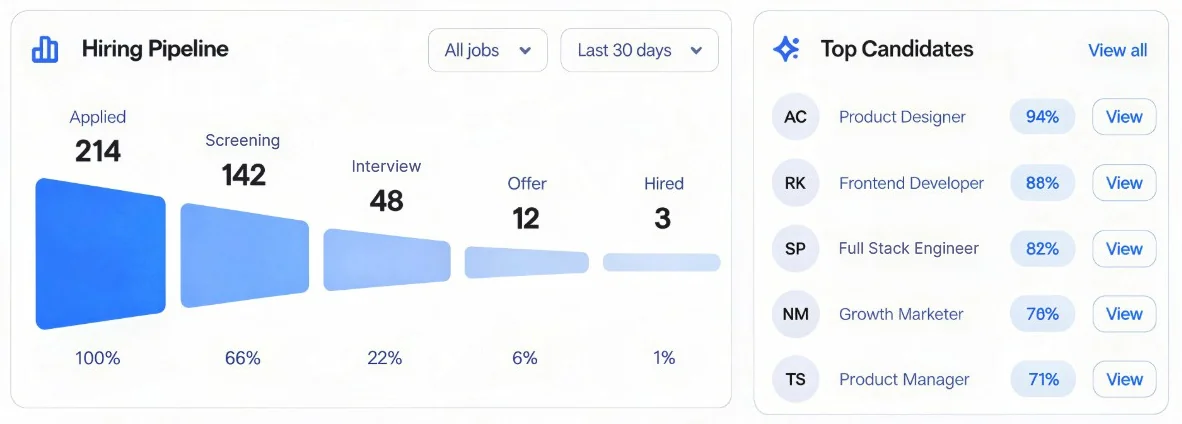
Pros:
- Flat price with unlimited jobs, candidates and team members
- Scores come with their breakdown and reasoning, not just a rank
- Careers page, pipeline, Google Calendar interviews, offers and analytics in one place
Cons:
- No interview kits, scorecards or approval workflows yet
- No native integrations; hires reach other tools through webhooks and an automation tool
- No free plan or trial
Pricing: Pro is $39/month or $199/year. Max, with talent sourcing and referrals, is $59/month or $299/year.
Best ATS for structured hiring
2. Greenhouse
Greenhouse is the benchmark for structured hiring: a defined interview plan, question kit and scorecard for every role, with feedback collected before the debrief. It has over 400 integrations, and its Talent Matching, which prioritises applicants against weighted criteria you set, is included on every plan.
Pros: The most mature structured-interview tools here; a huge integration marketplace; fraud detection on Plus and Pro.
Cons: Quote-only pricing; demo only; automation such as auto-reject starts at Plus.
Pricing: Quote only. For a deeper comparison, see our Greenhouse alternatives.
Best ATS for analytics-led startups
3. Ashby
Ashby bundles the ATS, a CRM, scheduling and analytics that other tools sell separately. Its AI-Assisted Application Review checks each resume against criteria you write and marks them met or not met, without giving an overall score.
Pros: Reporting that answers most hiring questions without a BI tool; published pricing up to 100 employees; 250+ integrations.
Cons: Custom fields, custom reports and approvals need the quote-only Plus plan; demo only; SSO costs extra on Foundations.
Pricing: Foundations costs $300 to $900 a month by headcount, up to 100 employees. More in our Ashby alternatives guide.
Best ATS with a built-in CRM
4. Lever
Lever treats every candidate as a long-term relationship, so past applicants and sourced prospects can be nurtured until the right role opens. Its core platform includes AI fit scores with written justifications and AI interview summaries.
Pros: ATS and CRM in one product; AI screening and interview notes included; 300+ integrations.
Cons: Pricing on request; no trial; some add-ons quoted separately.
Pricing: Quote only.
Best all-rounder for growing teams
5. Workable
Workable covers the whole hiring flow with little setup: posting to 200+ job boards, a careers page builder, interview kits, offers with e-signatures and an optional HR suite. Its Workable Agent scores candidates on up to 14 criteria and returns a ranked shortlist with reasoning.
Pros: A 15-day trial without a card; unlimited active jobs; 270+ integrations.
Cons: Priced by company size, from $299/month; texting, video and assessments are add-ons on Standard; the AI agent runs on credits.
Pricing: Standard is $299/month billed annually ($360 monthly) for 1–20 employees.
Best ATS for employer branding
6. Teamtailor
Teamtailor is built around the career site: a builder in 50+ languages, content that shows off your team, and a talent CRM for people who aren't ready to apply yet. AI features, including the Co-pilot add-on, summarise resumes and flag promising applicants.
Pros: Unlimited users and job postings on every plan; 450+ integrations; a strong career site with little effort.
Cons: Quote-only pricing; no advertised trial; Co-pilot is a separate add-on.
Pricing: Quote only.
Best ATS inside an HR suite
7. BambooHR
BambooHR is an HR system for small and mid-size businesses with applicant tracking built in. Job posting, candidate ratings, interview self-scheduling and offer templates with e-signatures are included, and new hires flow straight into employee records.
Pros: One system for hiring and HR; hires need no re-entry; offer letters with e-signature included.
Cons: No AI screening of applicants; job openings capped at 5, 25 or 50 by plan; you pay for the whole HR suite to get the ATS.
Pricing: Core, Pro and Elite are $10, $17 and $25 per employee per month above 25 employees; smaller companies pay a flat rate from $250/month. Our guide to BambooHR integrations covers how to fill its hiring gaps.
Best ATS for sourcing-heavy teams
8. Gem
Gem began as a sourcing and CRM tool and now sells an all-in-one platform with its own ATS. Its AI agents search 800M+ profiles and score and rank every inbound application with an explanation.
Pros: Sourcing, outreach and the ATS in one; hiring managers don't use a licence; a startup program for companies under 30 employees (six months at no cost, then 50% off the first paid year).
Cons: Custom pricing beyond the startup bands; AI agents need the pricier AI-powered seat.
Pricing: Its startup calculator shows $300/month for 1–10 employees billed monthly, with lower annual rates.
Best ATS on a tight budget
9. Breezy HR
Breezy HR keeps things simple: flat monthly plans, one-click posting to 50+ job boards, a drag-and-drop pipeline and self-scheduling. Applicant Insights gives each candidate a 0–10 score with an explanation, paid for with credits.
Pros: Flat pricing, not per user; a 14-day trial; a single-job plan at no cost.
Cons: Scorecards need the Growth plan; API and bulk export/import are on Custom Pro.
Pricing: Startup is $157/month billed annually ($189 monthly); Growth $273; Business $439.
Best ATS for Zoho users
10. Zoho Recruit
Zoho Recruit is a highly configurable ATS and recruitment CRM that fits naturally into the Zoho suite, with workflow automation, portals and posting to 75+ job boards. Its Zia AI matches candidates to jobs; candidate ranking is still on its roadmap.
Pros: Low per-recruiter pricing; a 15-day trial; deep customisation.
Cons: Active jobs are capped per licence; custom reports, webhooks and two-way email sync are Enterprise-only.
Pricing: Standard is $25 per recruiter/month billed annually ($30 monthly).
Also worth a look: Manatal (AI candidate scoring from $15 per user/month, billed annually), JazzHR (flat plans from $1,000/year for US small businesses) and Pinpoint (explained 1–10 AI match scores for in-house teams at 50+ employee companies).
What is an applicant tracking system?
An applicant tracking system (ATS) is software that manages hiring from job post to offer. It publishes your jobs, collects every application in one place, moves candidates through stages you define, schedules interviews, stores the team's feedback and keeps a record of every decision. Modern ATSs also use AI to read and prioritise applications.
ATS features by hiring stage
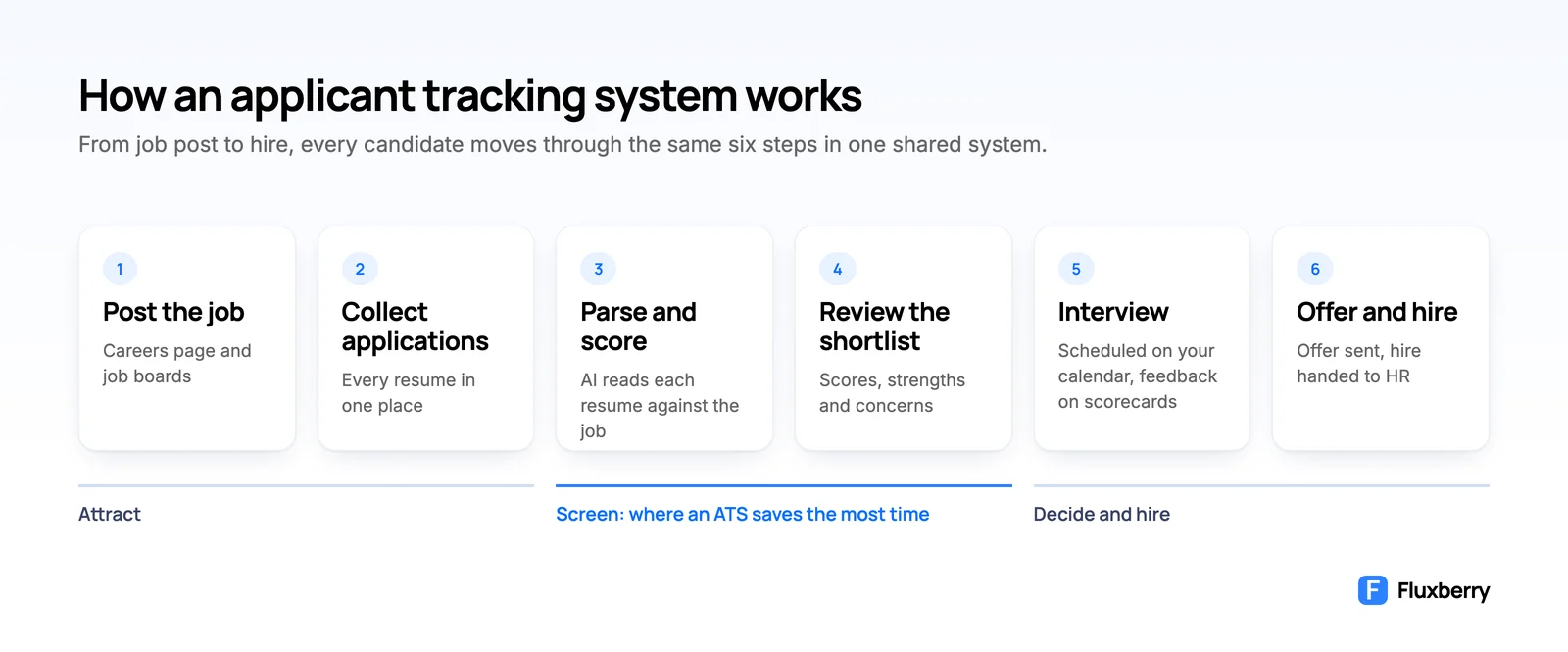
| Stage | What a good ATS does | What to check |
|---|---|---|
| Attract | Careers page, posting to job boards, application forms | Can you brand the careers page? Which boards are included? |
| Screen | Parses resumes, scores or checks them against the job, flags duplicates and fraud | Can you see why a candidate is recommended? |
| Interview | Scheduling from your calendar, interview kits, scorecards, shared notes | Do interviewers need a paid seat? |
| Decide and hire | Offers, approvals, e-signature, hand-off to HR | How does a hire reach your HR or payroll system? |
| Improve | Reports on sources, time in stage and drop-off | Can you export the data? |
How AI screening works, and what to ask vendors
"AI screening" now describes three quite different things:
- Scoring and ranking. The tool gives each applicant a score against the job and sorts the list. Fluxberry, Lever, Workable, Pinpoint, Breezy HR, Manatal and Gem all do this, and the better ones show the reasoning behind every score.
- Criteria checks. The tool marks each of your criteria as met or not met, without an overall score. Ashby and Recruitee work this way on purpose, to keep the ranking decision with a person.
- Matching. The tool prioritises applicants against weighted criteria or suggests candidates from your database, as Greenhouse's Talent Matching and Zoho's Zia Matches do.
None of these should make the hiring decision, and several vendors, including Greenhouse, Gem and Pinpoint, say theirs never advances or rejects anyone on its own. Before you switch one on, ask the vendor:
- What exactly does the score or match mean, and can a recruiter see the reasoning for each candidate?
- What's removed before the AI sees a resume? Several vendors redact personal details first.
- Has it been independently audited for bias, and can you see a summary? Ashby, Greenhouse and Gem all cite third-party bias audits.
- Is our data used to train models? Ashby and Pinpoint, for example, say they don't.
- How do we tell candidates? Some laws require it.
Two laws matter most today. In New York City, Local Law 144 requires a bias audit within a year before an automated tool is used to screen candidates, a published summary of that audit, and notice to candidates at least ten business days before use; fines run from $500 to $1,500 per violation. In the EU, the AI Act treats AI used to filter applications or evaluate candidates as high-risk, with duties for employers such as human oversight, monitoring and informing candidates; after a 2026 amendment those rules apply from 2 December 2027. This isn't legal advice, so check your own obligations with a lawyer.
How much does an ATS cost?
For a 10-person company, the published prices we found run from about $40 to $400 a month, but the pricing model decides how that changes as you grow.
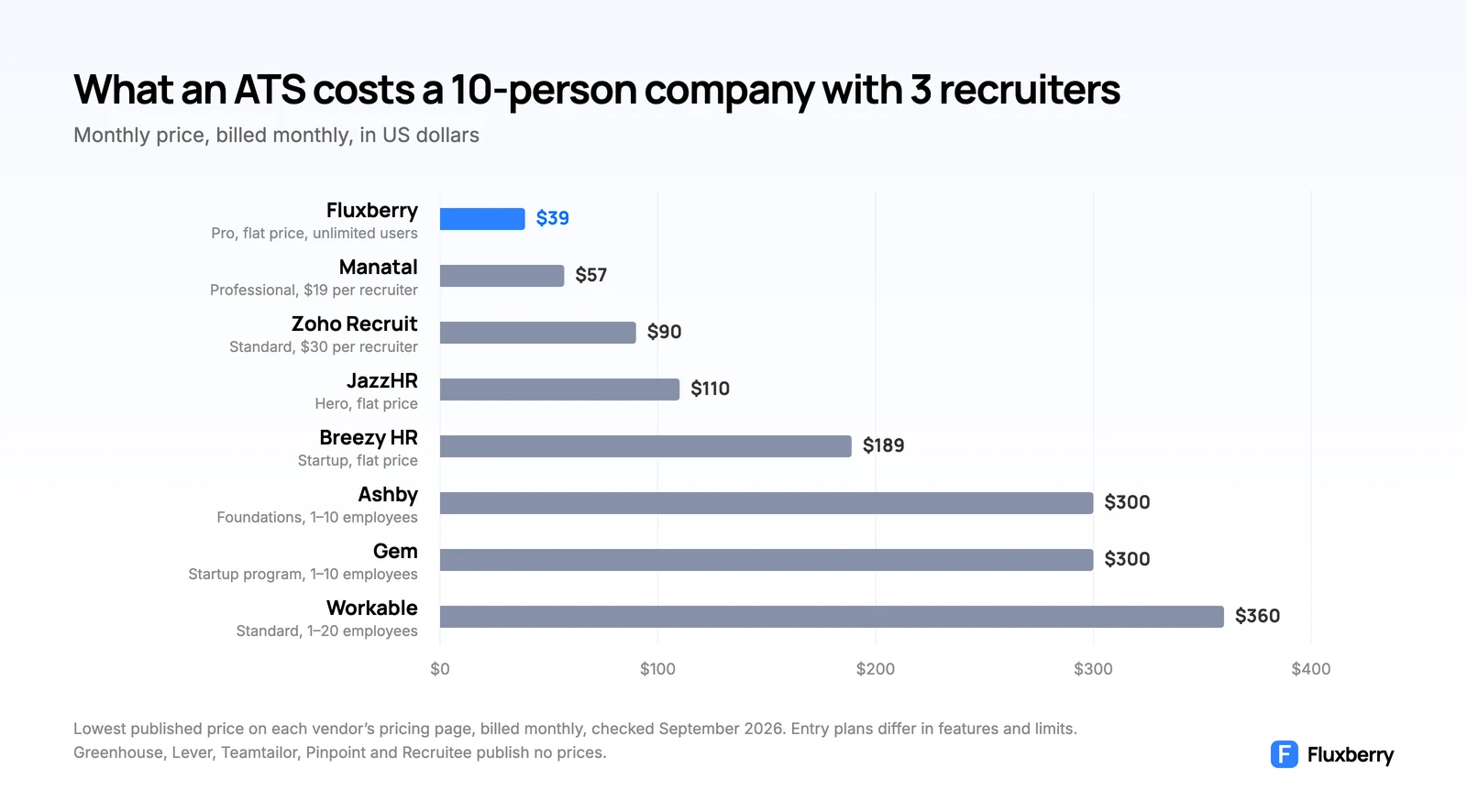
| Pricing model | How it scales | Examples |
|---|---|---|
| Flat per plan | Same price whoever joins the team | Fluxberry ($39/month), JazzHR (from $1,000/year), Breezy HR (from $157/month) |
| Company headcount | Rises as your company grows, not your hiring team | Ashby ($300–$900/month up to 100 employees), Workable (from $299/month), Gem (startup bands) |
| Per recruiter or user | Rises with every recruiter licence | Zoho Recruit ($25/recruiter), Manatal ($15/user), both billed annually |
| Per employee, inside an HR suite | Rises with total headcount | BambooHR ($10–$25 per employee above 25 employees) |
| Quote only | Negotiated | Greenhouse, Lever, Teamtailor, Pinpoint, Recruitee |
Also budget for add-ons (texting, video interviews, assessments, SSO, AI credits), implementation for demo-led products, and whether hiring managers need paid seats.
How to choose an ATS
| Factor | What to consider |
|---|---|
| Hiring volume | A few hires a year needs a light tool; dozens of roles need automation and reporting |
| Who reviews applications | If it's a founder or manager with no time, AI screening with visible reasoning matters most |
| Interview process | If many interviewers run structured loops, prioritise interview kits and scorecards |
| Team access | Check whether hiring managers and interviewers cost extra |
| Price model | Work out the cost at today's size and at twice your headcount |
| Integrations | List your HRIS, calendar, background checks and assessments, and check each one |
| Try before you buy | Prefer tools with a trial, or ask for a sandbox on a real role |
| Data export | Confirm you can export candidates and resumes if you leave |
How to set up an ATS in your first week
- Day 1: Create your workspace, add your logo and publish your careers page.
- Day 1: Set up your pipeline stages. Five is usually enough: applied, screened, interview, offer, hired.
- Day 2: Recreate your open roles, with clear must-haves the screening can use.
- Day 2: Connect your calendar and invite hiring managers.
- Day 3: Write email templates for application received, interview invite and rejection.
- Days 4–5: Move active candidates across, starting with anyone mid-interview.
- End of week: Check where applications arrive from and what's still sitting unreviewed.
Our guide to improving your hiring process covers what to change once the tool is running, and our map of recruiting software by type covers the tools you might add around your ATS.
Try Fluxberry as your first ATS
If you're a small team hiring without a recruiter, Fluxberry scores every applicant with the reasoning written out and gives the whole team one flat price. Create your Fluxberry workspace and have your first job live today.
Frequently asked questions
What is the best ATS for a small business?
It depends on how you hire. For a small team that wants applications scored and explained at a flat price, Fluxberry. For structured interviews, Greenhouse. For analytics, Ashby. For job-board reach with a trial, Workable. For the lowest flat price among established tools, Breezy HR.
How much does an applicant tracking system cost?
For a small business, published prices run from about $40 to $400 a month at 10 employees. Flat-priced tools like Fluxberry start at $39/month; Breezy HR from $157/month and Workable from $299/month billed annually; Ashby from $300/month; Greenhouse and Lever are quote-only.
Do small companies need an ATS?
Once you have more than one or two open roles, or more applicants than you can reply to within a few days, yes. An ATS stops applications getting lost, gives every candidate a reply and lets the whole team see where each hire stands.
What is the difference between an ATS and an HRIS?
An ATS manages candidates before they're hired: jobs, applications, interviews and offers. An HRIS (such as BambooHR) manages employees after they're hired: records, time off, payroll and benefits. Some HR suites include a basic ATS, and most ATSs hand new hires to an HRIS.
Is AI resume screening fair?
It can be, if it's used as decision support. Look for tools that show the reasoning behind every score, strip personal details before scoring, have been independently audited for bias, and leave every decision to a person. Some places, such as New York City, require bias audits and candidate notice by law.
What is the easiest ATS to set up?
Tools with self-serve sign-up and published pricing are quickest: Fluxberry, Breezy HR, Workable, Zoho Recruit and Manatal can all be running the same day. Demo-led products such as Greenhouse, Lever and Pinpoint typically need an implementation period.
Founder of Fluxberry
Sayandeep builds Fluxberry, an AI native hiring platform for small teams, and writes about applicant tracking systems, recruiting software and running a faster hiring process.